
Foundation issues reduce your home’s market value by 10-30% depending on severity, with minor cracks causing 5-10% losses while severe settlement exceeds 20% depreciation. You’ll face restricted financing options since FHA, VA, and USDA loans require structural soundness, shrinking your qualified buyer pool to primarily investors. Repair costs range from $2,200-$8,100 for typical issues, but repairing before listing protects 10-15% of market value versus selling as-is. Strategic timing and proper disclosure documentation determine your best exit approach.
How Foundation Problems Impact Your Home’s Market Value
When foundation problems emerge in your home, they’ll immediately trigger a measurable decline in market value that ranges from 10% to 30% depending on the severity and geographic location. Minor cracks typically reduce value by 5% to 10%, while severe settlement or bowing walls exceed 20% losses. This depreciation directly affects your financial freedom and exit strategy flexibility. Additionally, many homeowners are unaware that traditional financing often falls short when dealing with properties that have structural damage.
Buyer psychology works against you when structural issues surface. Most buyers, particularly first-time purchasers, view foundation problems as high-risk investments requiring substantial future capital. This perception shrinks your qualified buyer pool and reduces competitive offers. Resale timing becomes critical as foundation issues extend market exposure.
Appraisers factor structural damage into valuations, while lenders restrict financing options. FHA, VA, and USDA loans require structural soundness, further limiting potential buyers and forcing price concessions. Properties with unresolved foundation problems typically experience longer market exposure and weaker negotiating positions compared to structurally sound homes.
Legal Disclosure Requirements When Selling With Foundation Issues
Beyond market value implications, you’ll face strict legal obligations to disclose foundation problems to potential buyers. Most states mandate written disclosure through standardized forms, protecting you from future seller liabilities while ensuring transparency. Disclosure timelines typically require providing this information before closing, giving buyers adequate time to assess risks.
Your disclosure responsibilities include:
- Known foundation damage – Document all cracks, settling, shifting, or structural compromises you’re aware of.
- Past repair history – List dates, contractors, methods used, and any transferable warranties from previous foundation work.
- Ongoing issues – Report unresolved problems, water intrusion, or drainage concerns affecting foundation stability.
- Supporting documentation – Attach inspection reports, engineering assessments, and repair records when available; clear titles are essential to ensure no liens or judgments impact the sale.
Failure to disclose can result in lawsuits, forced sale rescission, and substantial financial penalties. Attempting to hide foundation issues through temporary fixes like caulking, painting, or cosmetic repairs creates additional legal liability for sellers.
Strategic Approaches: Repair Before Sale vs. Selling As-Is
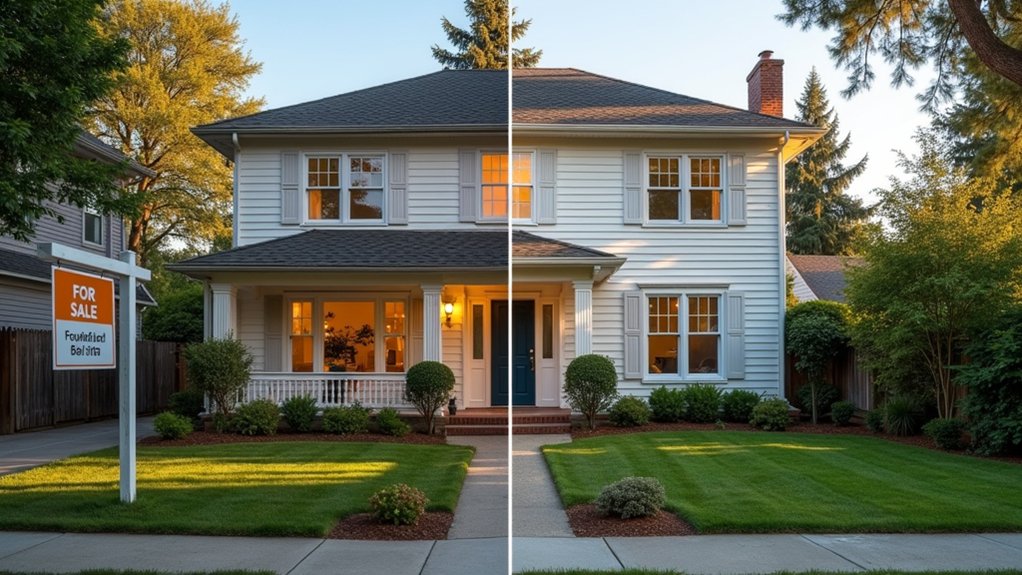
You’ll need to weigh two distinct paths when foundation issues surface: investing in repairs before listing or selling the property as-is with disclosed defects.
Repairing beforehand protects 10-15% of your home’s market value, with costs ranging from $2,200 to $8,100. This staged presentation attracts broader buyer pools and enables premium pricing with documented warranties.
Conversely, selling as-is typically reduces sale prices by 10-15% but eliminates upfront repair investments. Your market shrinks to investors and flippers, extending listing duration and increasing carrying costs.
Repaired foundations facilitate standard buyer financing and mortgage approvals, while foundation issues often complicate lending processes. Early detection typically leads to simpler, less expensive repairs that can make the repair-before-sale option more financially viable.
Consider your timeline, available capital, and risk tolerance when determining which strategy maximizes your net proceeds and aligns with your exit objectives.
Understanding Buyer Concerns and Market Perception
Foundation problems set off alarm bells in buyers’ minds, triggering immediate concerns about structural integrity and potential safety hazards.
Understanding buyer psychology reveals why foundation issues create such potent market resistance, even when repairs seem manageable.
Inspection anxiety drives buyers to scrutinize every visible sign of structural compromise:
- Visual damage patterns – Bowing walls, stair-stepping cracks, and gaps between windows signal hidden system failures
- Safety concerns – Uneven floors and unstable staircases create immediate liability fears
- Financial uncertainty – Anticipated repair costs ranging from $4,381 to $100,000 trigger worst-case scenario thinking
- Resale vulnerability – Future marketability concerns amplify current purchase hesitation
Foundation issues make homes significantly harder to sell, creating extended listing periods and forcing sellers to accept below-market offers. You’ll face reduced buyer pools, extended market time, and automatic 10-20% valuation discounts as buyers factor maximum repair expenses into their offers, regardless of actual damage severity.
Navigating Inspection Processes and Repair Cost Negotiations

When buyers uncover foundation issues during their due diligence period, you’ll enter a critical negotiation phase that demands strategic preparation and technical documentation. Understanding inspection timelines empowers you to control the process rather than react defensively.
| Inspection Phase | Duration | Key Actions |
|---|---|---|
| Preliminary Assessment | 90 minutes | Visual examination, moisture detection |
| In-depth Investigation | 2-4 hours | Laser measurements, soil analysis |
| Analysis and Report | 24-48 hours | Documentation compilation |
| Buyer Review Period | 3-7 days | Cost estimate gathering |
| Repair Negotiation | 1-3 days | Strategic positioning |
Professional engineers provide credible assessments that establish factual baselines for repair negotiation discussions. You’ll leverage moisture meter readings, laser level measurements, and soil probe data to justify your position, transforming technical findings into negotiating advantages that protect your financial interests.
Three-Step Foundation Solution
You can bypass the complex foundation repair process entirely through our streamlined three-step acquisition system.
Our methodical approach eliminates the need for costly pier installations, excavation work, and the two-to-three-month post-repair monitoring period that typically follows stabilization procedures.
This process requires only your property details, our cash offer assessment, and your preferred closing timeline.
Tell Us About Your Property
Before any effective foundation repair can begin, our all-inclusive three-step assessment process starts with gathering critical details about your property’s structural characteristics and current condition. This data collection phase eliminates guesswork and establishes the foundation for targeted solutions.
We’ll need specific information about your property history and occupancy status to develop an accurate repair strategy:
- Foundation type documentation – Slab, pier and beam, or basement construction details
- Property age analysis – Historical timeline affecting structural integrity
- Visible damage assessment – Exterior cracks, interior misalignments, and settling patterns
- Environmental factors – Drainage conditions and terrain influences on foundation stability
Your property’s unique characteristics determine our inspection approach, equipment selection, and repair methodology. This methodical data gathering confirms you receive solutions tailored to your specific foundation challenges.
– You submit your information through a simple form or a quick phone call
Starting off your foundation assessment is straightforward – you’ll submit essential property details through either our streamlined online form or a brief phone consultation with our technical team.
This online intake captures critical data including your foundation type, property location, and visible distress indicators. During phone screening, you’ll describe specific concerns while our engineers document access requirements and structural symptoms.
Your information flows directly to structural engineers who’ll prepare targeted inspection protocols.
We’ll gather foundation construction details, property age, and soil condition factors that influence assessment scope. This methodical data collection guarantees you’re not paying for unnecessary evaluations while assuring exhaustive coverage of actual problem areas.
The process eliminates guesswork, giving you control over inspection focus and eliminating wasted time on irrelevant foundation zones.
Get a Fair Cash Offer
Foundation repairs often spiral beyond budget projections, with national averages reaching $5,100 and severe structural damage exceeding $30,000 for complete underpinning systems. Cash offers eliminate repair negotiations and timeline uncertainties that traditional buyers create.
Your fair cash evaluation considers:
- Current foundation damage severity – from minor $300 crack sealing to $25,000 sinking foundation repairs
- Repair cost calculations – including piering at $1,000-$3,000 per unit and wall reinforcement up to $12,000
- Property-specific factors – home size, soil conditions, and structural assessment requirements
- Market positioning adjustments – accounting for foundation type costs ranging $350-$25,000
Quick closings bypass lengthy inspection periods and repair contingencies. You’ll receive transparent pricing based on current market data, foundation repair estimates, and comparable property analysis, providing immediate liquidity without repair investments.
– We’ll quickly assess your property and present a no-obligation cash offer
Getting straight to the point, our three-step foundation assessment eliminates guesswork through systematic property evaluation and data-driven offer calculations.
You’ll receive quick visuals through thorough documentation that captures horizontal cracks exceeding ¼-inch, bowing walls, and moisture intrusion patterns.
Our inspectors measure soil conditions, check plumbing systems, and evaluate structural integrity using advanced diagnostic tools.
During interior and exterior walkarounds, we document misaligned doors, uneven floors, and foundation wall distress with high-resolution photography.
You’ll get a rapid estimate within 24-48 hours based on repair costs, market comparables, and damage severity metrics.
This non-invasive process covers all accessible areas without obligation.
The detailed report includes clear problem descriptions, repair recommendations, and supporting evidence that drives your cash offer calculation.
Choose Your Closing Date
Once you’ve accepted our cash offer, you’ll lock in your preferred closing timeline that aligns with your relocation needs and financial objectives.
You’re no longer constrained by seasonal timing considerations or contractor availability that typically complicate traditional repairs.
Your closing date flexibility includes:
- Immediate Settlement – Close within 7-14 days without waiting for ideal repair windows
- Strategic Timing – Coordinate with your moving schedule, job changeover, or family events
- Market Independence – Avoid peak season delays when contractors book months ahead
- Weather Immunity – Eliminate concerns about soil conditions, temperature ranges, or precipitation impacts
You’ll bypass the uncertainty of foundation repair scheduling that often extends 2-4 months during peak demand periods.
This streamlined approach delivers predictable timelines while maximizing your financial recovery from a compromised property asset.
– If you accept, you pick the date that works best for you, and we handle the paperwork
Accepting our all-encompassing foundation solution triggers a streamlined three-step process that eliminates your administrative burden while maintaining complete schedule control. You’ll select your preferred completion date based on personal scheduling requirements, while our team manages thorough paperwork transfer protocols. This systematic approach removes complex administrative tasks from your responsibility, guaranteeing seller convenience throughout the transaction.
Our documentation specialists handle agreement details, disclosure requirements, and warranty documentation with methodical precision. You’re liberated from steering legal compliance complexities while maintaining authority over timing decisions. This professional paperwork transfer system accelerates closing timelines by reducing potential documentation errors and guarantees transparent communication between all parties.
The result: you retain scheduling autonomy while we execute the technical administrative framework, delivering the freedom to focus on your changeover priorities rather than bureaucratic processes.
Final Thoughts
You’ve now mastered the art of transforming your structural nightmare into a marketable asset. Armed with your disclosure forms, repair estimates, and negotiation tactics, you’re ready to convince buyers that your sinking foundation represents “character” and “investment opportunity.” Remember, it’s not subsidence—it’s “natural settling.” Those hairline cracks aren’t structural failures—they’re “vintage charm indicators.” Deploy your three-step solution with the precision of an engineer and the optimism of a carnival barker.
References
- https://allstarbasements.com/can-you-sell-a-home-with-foundation-cracks/
- https://levelengineering.com/b/foundations/selling-or-buying-house-with-foundation-issues/
- https://www.homelight.com/blog/selling-a-house-with-foundation-issues/
- https://heliconusa.com/the-challenges-of-selling-a-home-with-foundation-issues/
- https://www.usstn.com/blog/the-impact-of-structural-and-foundation-damage-on-home-value
- https://www.thisoldhouse.com/foundations/seller-didnt-disclose-foundation-problem
- https://foundationrepairhub.com/does-foundation-repair-increase-home-value/
- https://terrafirmleveling.com/blog/how-foundation-issues-can-affect-your-homes-value/
- https://www.american-waterworks.com/about-us/news-and-events/40038-how-foundation-problems-can-affect-the-value-of-your-home.html
- https://www.abnamro.com/research/en/our-research/sustainaweekly-does-knowledge-of-foundation-problems-impact-house-prices